|
| Some color schemes for Pawnee warriors, poorly drawn by me ;) |
1. Clothing:
Pawnee clothing was mostly made of tanned hide or traded cloth. Hide was often smoked over a fire thus getting a light yellow color.
Trade cloth was quickly adopted by the Pawnee, who had their first contacts with Europeans (Spanish and French) relatively early.
Pawnee warriors liked to strip down for battle, often wearing only breechclout and moccassins (or going enterely naked, according to several accounts, from the 18th century onwards).
1.1. Decoration
Leggings and moccassins were decorated with quills or beads. The beads used by the Pawnee were fairly small.
- Beads: Pawnee beaded using the lazy stitch technique. The blackground color was usually white, with geometrical forms in a contrasting color (Fig. 1). Bear paws were also a common beaded design (Fig.2). The beaded pannels in later cloth leggings were fairly broad and on the the front of the legging, whereas older hide leggings had narrower beaded lines on the sides.
 |
| Fig.1: Some Pawnee beaded designs on leggings |
 |
| Fig. 2. Some examples of beaded bear paw |
- Ribbons: some garments could be decorated with ribbons along the edges. The most popular colors were red, followed by white and then yelow, blue and lastly dark blue. Some warriors decorated their heads, hair or ears with narrow strips of ribbon too.
- Painted designs: leggings and warshirts could also have painted designs on it. Some usual designs were celestial symbols, small painted hands or brown dots and circles. Hide leggins often had horizontal brown lines.
1.2. Breechcloth
The breechcloth could be made of tanned hide or trade cloth.
- Trade cloth: usual trade cloth colors were scarlet red and dark navy blue, but green or black were also popular. Sometimes the white selvage line were left at the end of the breechcloth. In many ledger drawings they are depicted black or very dark brown.
- Hide: brown or light warm yellow.
1.3. Leggings:
Hide leggings: Leggings were traditionally made of tanned hide and usually had fringes and thin beaded stripes along the sides. These fringes were very often made of human hair. Sometimes there were feathers alongside the fringes or scalp locks.
Cloth leggings: Leggings could also be made of traded cloth, in which case they had flaps rather than fringes, and broad beaded vertical panels on the front. The panels had normally a white background and dark geometrical designs (Fig. 1). Usual colors for leggings could be scarlet red or dark navy blue in case of stroud cloth, also tan or green if blankets were used to confectionate the leggings. In many ledger drawings they appear to be black or a very dark brown.
Garters: Pawnee leggings were very often gartered below the knees. The garters could be made of vowen grass fiber or buffalo hair and were often beaded in a white background color with geometrical designs (Fig.2).
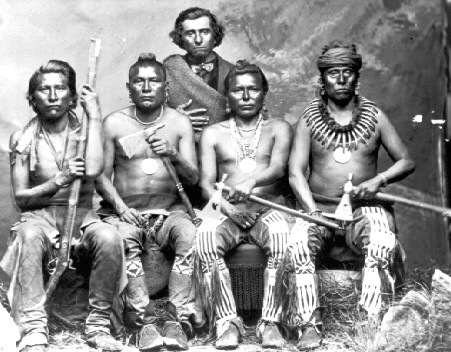 |
| Pawnee scouts. Note the beaded bands along the leggings and the geometrical designs on the garters |
1.4.Warshirts
With some exceptions, hide warshirts were seldom worn. They tended to be fairly plain but with very long fringes at the sleeves. They would be also yellowish due to the smoking process of the hide.
 |
| Warrior with hide shirt and otter fur turban. The shirt is based on an exemplar in the Brooklyn Museum |
1.5. Moccassins:
Moccassins could have a quilled or beaded strip at the edges or some decoration on the instep, but could also be relatively plain. They had often very long flaps and in ledger art they are often depicted high-cuffed and in a black or very dark brown color.
..............................................................................................................................................................
2. Accesories
2.1. Necklaces
Like in the case of earrings, Pawnee warriors used to wear several necklaces. Necklaces could be made of round big beads (smaller "pony beads" later on) in different colors, or white elongated dentalium shells or later hair pipes. Chokers, often made of quilled bands, but also of dentalium shells, could also be worn.
 |
| Sharitarish, by Charles Bird King. Note the necklace made of beads and the peace medal |
Bearclaw necklace: A typical Pawnee item, these were made of brown otter skin and the claws of a grizzly bear, with the otter's head and tail still attached (Pawnee bearclaw necklaces were the only ones with the head of the otter). They could be decorated with beads in form of rosettes or bands.
 |
| Warrior with bearclaw necklace and cloth turban |
2.2. Headgear:
Cloth turban: Turbans (made of cotton sashes or shawls) were a typical Prarie feature and could be made of very different colors. Black was usual amongst Pawnee, but red, green or yellow, being typical sashes' colors, could also be used.
Otter fur turban: Another type of turban was made of the entire pelt of an otter, sometimes with the fur of the head and/or tail attached and different decorations (beads, buttons, feathers, red cloth...). There were lots of different styles and types and some of the most impressive ones had a huge decorated triangle made of cloth and/or fur on the front side.
Roach: Several tribes from the eastern praries wore the roach, a tuft made of deer tail, horsehair or porcupine hair (among others), attached to the scalplock via a roach-spreader, where eagle feathers were also attached. It was normally dyed red with vermilion.
_Pawnee_-_1985.66.110_-_Smithsonian_American_Art_Museum.jpg/494px-George_Catlin_-_La-w%C3%A1h-he-coots-la-sh%C3%A1w-no%2C_Brave_Chief%2C_a_Skidi_(Wolf)_Pawnee_-_1985.66.110_-_Smithsonian_American_Art_Museum.jpg) |
| La-wáh-he-coots-la-sháw-no, Brave Chief, a Pawnee painted by Catlin. Note the roach, dyed red. |
2.3. Bracelets, earrings, peace medals:
Earrings: Pawnee warriors had their ears perforated in many places and wore lots of earrings in every piercing. These could be clusters of beads or dentalium shells. Metal ball and cone earrings obtained by trade were also very popular.
Bracelets: metal armbands (iron, tin, brass) were widely worn. Another option were hide quilled or beaded bands.
Peace medals: These were large presentation coins worn as necklaces and issued by the Government of the United States or by fur-trade companies for native chiefs and warriors. They were objects of prestige and power among the indians.
 |
| Warrior with a peace medal and necklaces made of dentalium shells |
3. Hair and hair decoration
The archetypical Pawnee hairstyle is common to many prarie and eastern woodland peoples. Most of the head was shaved letting only one low central ridge and a long braid at the back (the scalplock). Sometimes the hair could be dyed red. On top of the hair the roach was often worn (go to 2.2.), usually with one or several eagle feathers.
Sometimes the shaved hair would grow over the winter so it wasn't uncommon to find Pawnee men with very short hair on the sides of the head:
 |
| Te-ah´-ke-ra-lée-re-coo, Pawnee, by Catlin. Note the short hair besides the roach. |
4. Shields
Shields could be decorated with fringes, scalp locks, feathers or cloth.
The most usual painted designs were geometrical forms, most probably celestial symbols (lines, circles, crescents...). An example with figurative art on it (allegedly Pawnee) can be seen here. Another interesting Pawnee shield is also displayed in the British Museum.
 |
| Some examples of Pawnee shield designs according to artistic depictions. Colors given when known. |
5. War Paint
Body paint was of great importance among the Pawnee. As a curiosity, 18th century Pawnee are depicted in the Segesser hide (testimony of Villasur's defeat by the Pawnee in 1726) in a great variety of styles, in what is, in fact, one of the firsts testimonies of the use of body paint among Plains indians:
 |
| Segesser II painted hide. Note the cutlasses provided by the French to the Pawnee, who are fighting naked. |
19th century Pawnee often painted their bodies with stripes of red and yellow. The eyelids were carefully painted red with vermilion, as were the upper part of the head and/or also parts of the face. Sometimes, some details were painted black (Fig. 4). Scouts painted their faces white symbolizing the wolf, a powerfull medicine while scouting.
 |
| Fig. 4: Pawnee face paint examples shown in Catlins' paintings |
 |
| La-dóo-ke-a, a Pawnee, by Catlin. Note the buffallo head painted on chest and face |
7. Warrior societies
Unlike other Plains people, most of Pawnee warrior societies hadn't much of specific regalia or warpaint associated to them, as every warrior could paint himself as he pleased and carry his weapons of choice.
There were, though, some exceptions:
- Crow lance society: their members wore the quiver over the right shoulder instead of the left.
- Black Heads: their members used white warpaint.
- Children of the Iruska (a contrary society): according to Murie "they were always painted black as if ready to fight". They carried the skin of a blackbird on the head.
Most of Pawnee warrior societies could be distinguissed by the special lances associated with them:

- Left: BRAVE RAVEN society, whose members lead in hunt and in the line of battle. The feathers were crows', the shaft is wrapped with buffalo skin.
- Middle: FIGHTING LANCE society. That was a war society comprised of many chiefs and warriors. The shaft was wrapped with swan skin, feathers are eagle except the shorter ones, that are owl. The point is iron.
*This lance is almost identical in form with the Skidi RED SOCIETY lance (that had four clusters of feather along the shaft instead of three) and could also be used as that. Members of this society were called to lead in war and for act as police in battle. In this case the shaft was wrapped in otter skin instead of swan.
*Removing the spear point and the two longer feather, it could represent the BLACK HEADS society lance. They acted as a sort of police in the line of battle and painted their faces white. They wore a tuft of crow feathers. The shaft of the lance is wrapped with swan skin, the feathers were crow and raven.
- Right: KNIFE LANCE, whose members were also active in the line of battle. The cloth of the lance was made alternating black and red broad bands. The feathers were eagle.
Painted examples:

Sources:
-Thomas E. Mails: The Mystic Warriors of the Plains
-Thomas E. Mails: Dog Soldier Societies of the Plains
-Josephine Paterek: Encyclopedia of American Indian Costume
-Ronald P. Koch: Dress Clothing of the Plains Indians
-James R. Murie: Pawnee Indian Societies.
-Andrew McGinnis: Counting Coup and cutting horses
-Michael Bad Hand: Plains Indians Regalia and Customs
-Michael Johnson: Encyclopedia of Native Tribes of North America
-George Catlin: Letters and Notes on the Manners, Customs, and Conditions of North American Indians.